Got hurt? You deserve more than a vague offer. In this guide we walk you through a personal injury case evaluation from start to finish. You’ll learn how to gather proof, work out damages, check insurance limits, and gauge the odds of a fair settlement. By the end you’ll know exactly what numbers to put on the table and how to protect your right to compensation.
Step 1: Gather and Document All Evidence
The first thing you do in a personal injury case evaluation is collect every piece of proof you can find. Proof is the backbone of your claim. Without it, the insurance adjuster can shrug and say, “We don’t see the damage.”
Start with the accident scene. Take photos of vehicle damage, skid marks, broken glass, and any visible injuries. Snap pictures from several angles and, if possible, a wide shot that shows the whole area. Do this right away while the scene is fresh.
Next, get the police report. Even if the officer didn’t write a detailed narrative, the report will list the parties involved, the time, and any citations. That small piece of paperwork can become a key fact later.
Medical records are the second pillar of proof. Medical records show exactly when you sought care and what doctors diagnosed. Request full treatment notes, lab results, imaging reports, and prescriptions. The more complete the file, the harder it is for the defense to claim you were fine.
Keep a daily journal. Write down pain levels, medicines you take, and how the injury stops you from doing normal chores. Use a simple table or a phone note app – just be consistent. Your journal fills gaps that receipts can’t.
Don’t forget receipts. Every bill for X‑rays, physical therapy, or a new brace adds up. Even a receipt for a cab ride to a doctor counts as a cost you wouldn’t have had otherwise.
Witness statements matter, too. Ask anyone who saw the accident to write a short note with their name, contact info, and what they saw. If they’re willing, record a quick voice memo. Those statements can counter an insurance adjuster’s claim that you slipped and fell on your own.
Organize everything as you collect it. Create a folder for each type of document – photos, medical, police, receipts – and label each file with the date. Use a cloud service so you can share the whole set with your attorney in one click.
Tip: Save a copy of every email you send or receive about the claim. Email trails prove you acted promptly and responsibly.
When you hand your files to a lawyer, they will sort the stack, flag the strongest pieces, and note any gaps that need filling. Think of your evidence folder as the blueprint for the claim.
Finally, make a backup. Save a zip file on an external drive or a USB stick. If your email crashes or your phone dies, you still have a copy.

Step 2: Establish Liability and Fault
Liability is the legal word for “who caused the harm.” In a personal injury case evaluation you must show that another party’s negligence led to your injuries.
Start with the facts you already gathered. The police report often lists who was at fault. If it says the other driver ran a red light, that’s a clear starting point.
Next, look at traffic laws or safety codes that apply. For a slip‑and‑fall, check whether the property owner kept the floor clean or posted warning signs. For a workplace injury, see if the employer followed OSHA rules.
Interview witnesses again. Ask them to describe what they saw in plain language. “I saw the driver swerve into the lane without signaling” is stronger than “I think the driver might have been speeding.”
Gather expert opinions when needed. An accident reconstructionist can explain how speed and impact angles line up with the damage you captured in photos. A medical expert can tie your injuries directly to the event.
Document every piece of evidence that points to the other party’s breach of duty. Duty means they had a responsibility to act safely. Breach means they failed.
When you have a clear chain – duty, breach, causation, damages – you have a solid foundation for the personal injury case evaluation.
Tip: Write a short “fault timeline” that lists each event, who did what, and why it mattered. Your attorney can turn that into a persuasive narrative.
To see how a lawyer helps you build this chain, read how a personal injury lawyer reviews evidence. The article walks through the same steps we just covered, but from a lawyer’s perspective.
Once liability is clear, the rest of the personal injury case evaluation becomes easier because the insurer can’t argue “it wasn’t my fault.”
Remember, even if you think the fault is obvious, the insurer will still try to shift blame. That’s why you need solid proof.
Step 3: Calculate Economic Damages
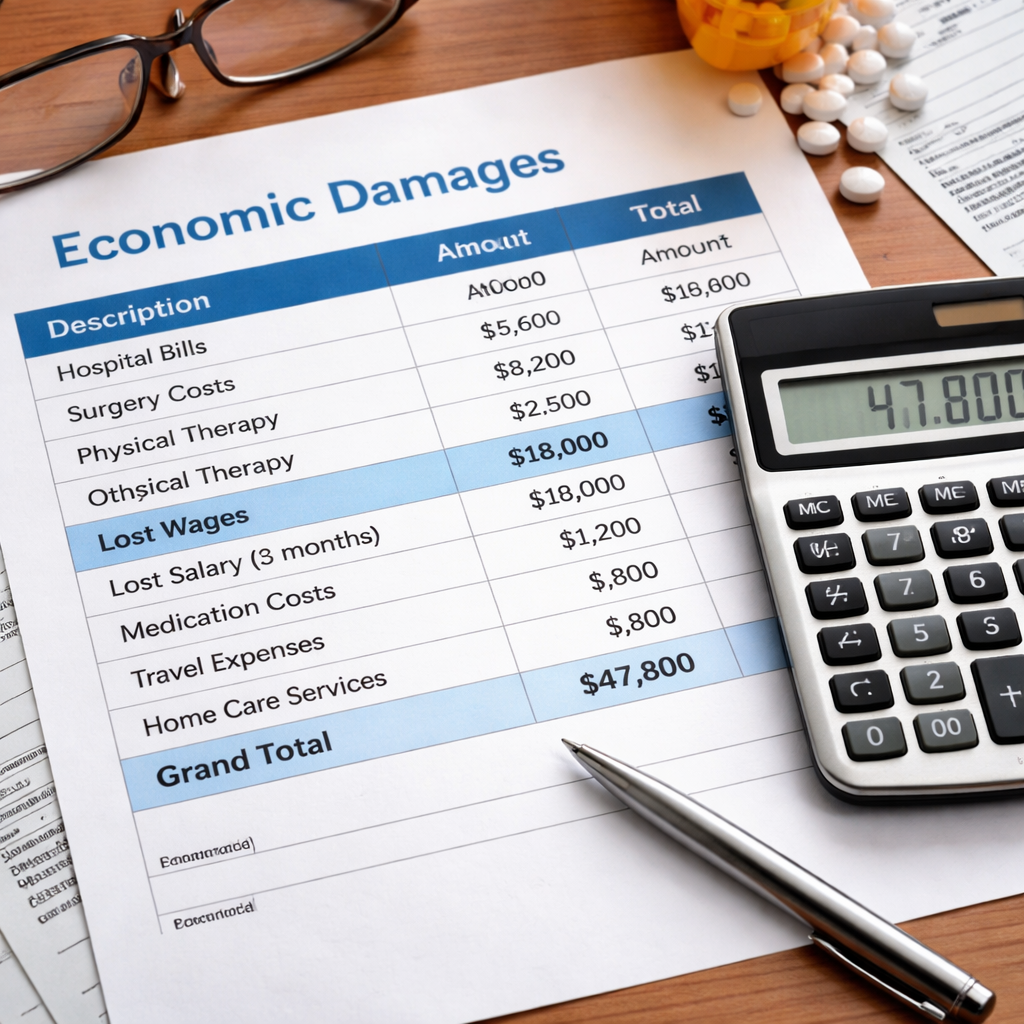
Economic damages are the money‑type losses you can prove with receipts, bills, and pay stubs. In a personal injury case evaluation you add up every dollar you’ve spent or lost because of the injury.
Start with medical costs. Pull every invoice for hospital stays, doctor visits, surgery, medication, and physical therapy. KRW Lawyers explains that these bills form the base of economic damages. Total them and keep the list in a spreadsheet.
Next, add lost wages. Look at your recent pay stubs to see your daily or hourly rate. Multiply that rate by the number of workdays you missed. If you’re salaried, use your annual salary divided by 260 (the typical workdays in a year) to get a daily figure.
Don’t forget future lost earnings. If your injury will keep you from returning to the same job, a vocational expert can estimate the reduction in lifetime earnings. Those numbers go into the claim as “future lost wages.”
Other out‑of‑pocket costs matter, too. Transportation to medical appointments, childcare while you’re in the hospital, or home‑care services all count. Keep receipts for each trip, each babysitting session, and each hour of help.
Here is a quick table you can copy into a spreadsheet:
| Category | Example | How to calculate |
|---|---|---|
| Medical bills | Hospital stay $5,200 | Sum all itemized bills |
| Lost wages | 8 days off at $200/day | Days missed × daily rate |
| Future earnings loss | Reduced salary $2,000/mo for 5 years | Monthly loss × months |
| Other costs | Taxi rides $45 | Add all receipts |
When you add every line, you have the total economic damages. This number is easy for an insurer to see because it’s backed by paper.
Tip: Keep a column for “date received” so you can show the court a clear timeline of when each cost occurred.
To prove lost wages, Justin Minton Law outlines the exact docs you need. The guide lists pay stubs, tax returns, and employer letters as key evidence.
After you total everything, you have a concrete figure that will anchor your settlement demand. The higher this number, the more leverage you have in negotiations.
Step 4: Assess Non‑Economic Damages
Non‑economic damages cover the pain, suffering, and loss of enjoyment that you can’t put a price tag on. In a personal injury case evaluation you still need a number, even though it’s less concrete.
The most common way to get that number is the multiplier method. First, add up all economic damages – the total you just calculated. Then multiply that sum by a factor between 1.5 and 5. The factor depends on how severe your injury is, how long you’ll feel pain, and how much your life changed.
For example, if your economic damages are $30,000 and you suffered a serious back injury, a multiplier of 3 might be fair. That gives you $90,000 for non‑economic losses.
Another option is the per‑diem method. You pick a daily rate that reflects the hardship of each day you’re in pain. Then multiply that rate by the number of days until you reach maximum medical improvement. If you set $150 per day for 200 days, you get $30,000.
Both methods have pros and cons. Multipliers are quick and work well for long‑term injuries. Per‑diem gives a clear daily picture but can be harder to justify for lifelong conditions.
Tip: When you talk to your lawyer, bring any diaries that note how many days you missed family events, hobbies, or sleep. Those notes help the attorney argue for a higher multiplier.
The multiplier method is explained in depth by Brandon J. Broderick’s article. It walks through how the factor is chosen based on injury type, age, and impact on daily life.
Remember, non‑economic damages are a negotiation tool. The insurer will try to keep the multiplier low. Your job is to show that the pain, anxiety, and loss of life quality are real and lasting.
Finally, write a short personal statement that describes how the injury changed your routine. Mention missed birthdays, the fear of driving again, or the constant ache that stops you from playing with your kids. A vivid story can tip the scales in your favor.
Step 5: Consider Insurance Policy Limits and Coverage
Even with a perfect personal injury case evaluation, the amount you can collect may be capped by the at‑fault party’s insurance policy. That cap is called the policy limit.
Start by finding out the limits. Ask the other driver’s insurer for a copy of the liability policy. In many states, the minimum auto liability is $25,000 per person and $50,000 per accident. If the driver only has the minimum, that could be the ceiling for your claim.
If the limit is low, you have a few options. One is to look for other liable parties – maybe a car manufacturer, a property owner, or a contractor. Each additional defendant may bring another policy to the table.
Another is to use your own uninsured/underinsured motorist (UIM) coverage. If you bought UIM, it can step in when the at‑fault driver’s limit is not enough. That coverage is often overlooked, but it can fill the gap.
Sometimes a business or a high‑net‑worth individual carries an umbrella policy. Those policies add extra layers of protection above the basic limits. Your attorney will check public records or request proof of such policies.
If all insurance sources fall short, you might pursue the at‑fault party’s personal assets. That’s tougher, but in cases of gross negligence a court may allow it.
Tip: Ask your lawyer to request the insurance declarations page early. Knowing the exact numbers helps you set realistic expectations.
The impact of low limits is explained by Gerstner Law’s overview of insurance limits. It shows how limits can shape the settlement strategy.
When you know the ceiling, you can decide whether to push for a higher settlement, add more defendants, or file a claim against your own policy. The personal injury case evaluation always ends with this reality check.
Step 6: Factor in Case Strength and Settlement Probability
Now that you have the numbers, you need to gauge how likely you are to get them. That part of the personal injury case evaluation is about risk.
Look at the strength of your evidence. Do you have clear photos, medical records, and witness statements? If yes, your case is strong. The insurer will know you can go to trial, and they may offer a fair settlement to avoid that.
Consider the defendant’s insurance company. Large insurers have deep pockets and experienced adjusters. They may lowball you at first but will settle if you have a solid case file.
Think about the jurisdiction. Some courts favor plaintiffs, others favor defendants. Research recent verdicts in the county where the accident happened. That data helps you set realistic expectations.
Settlement negotiations usually start with a demand letter. The demand should list all economic damages, a proposed multiplier for non‑economic losses, and a brief liability summary. Attorney at Law Magazine explains how a well‑crafted demand drives the negotiation. The letter shows the insurer that you mean business.
If the insurer counters with a low offer, your lawyer can file a reply that points out missing evidence or miscalculations. The back‑and‑forth continues until both sides find a middle ground.
Sometimes mediation is used. A neutral third party helps both sides talk. Mediation can break a stalemate and lead to a quicker settlement.
Tip: Always keep a written record of every phone call and meeting. Those notes become valuable if the case goes to trial.
If negotiations stall, you may need to prepare for trial. That doesn’t mean you will go to court, but the threat of a trial pushes insurers to settle.
Brandon J. Broderick’s guide on trials vs. settlements notes that over 95% of personal injury claims settle before trial. Knowing that statistic can help you decide whether to accept a reasonable offer or keep pushing.
In the end, the personal injury case evaluation gives you a clear picture: the total dollar value you seek, the insurance ceiling, and the odds of getting a fair deal. Use that picture to make an informed choice.
Frequently Asked Questions
What is the first step in a personal injury case evaluation?
The first step is to gather and document all evidence. That means taking photos, getting the police report, collecting medical records, saving receipts, and writing a daily journal of symptoms. Strong evidence turns a vague claim into a solid case and helps the insurer see the real impact of your injury.
How do I calculate my lost wages?
Start by locating recent pay stubs or tax returns. Multiply your daily or hourly rate by the number of workdays you missed. For future earnings, a vocational expert can estimate how the injury will affect your career path. Keep employer letters that confirm your time off; they strengthen the lost‑wage claim.
What is the multiplier method?
The multiplier method takes your total economic damages and multiplies them by a factor between 1.5 and 5. The factor reflects injury severity, recovery time, and life‑impact. A higher multiplier means a larger award for pain and suffering. Your lawyer will choose a factor that matches the facts of your case.
Can I recover more than the at‑fault driver’s insurance limit?
Yes, you can look for other sources of money. You might add claims against other liable parties, use your own uninsured/underinsured motorist coverage, or pursue the at‑fault driver’s personal assets. An umbrella policy can also add extra layers of coverage beyond the basic limit.
How important is liability in the evaluation?
Liability is crucial because you must prove the other party’s negligence caused your injury. Without clear liability, the insurer can argue you’re partly to blame, which reduces or eliminates compensation. Gather police reports, witness statements, and expert opinions to nail down liability.
What role does a settlement negotiation play?
Negotiation is where the numbers you calculated meet the insurer’s offer. A well‑written demand letter, backed by strong evidence, forces the adjuster to consider a fair payout. If negotiations stall, mediation or trial preparation can increase pressure for a better settlement.
Should I settle or go to trial?
That decision depends on case strength, insurance limits, and your personal risk tolerance. Most cases settle because trials are costly and uncertain. If your evidence is strong and the insurer’s offer is low, a trial threat can raise the settlement. Your attorney will weigh the pros and cons based on the personal injury case evaluation.
How long does a personal injury case evaluation take?
The timeline varies. Gathering evidence may take a few weeks, while calculating damages can add another few weeks. If insurance limits are low, you might need extra time to find other sources of compensation. Overall, expect the evaluation to take one to three months before you have a solid settlement figure.
Conclusion
Doing a personal injury case evaluation is like building a puzzle. You collect the pieces – evidence, liability proof, economic numbers, and non‑economic estimates – and then see how they fit together with the insurance limits. When you finish, you have a clear picture of what your claim is worth and how likely you are to get it.
Remember to document everything from day one, keep receipts, and write a daily journal. Use the multiplier or per‑diem method to turn pain into a dollar amount. Check the at‑fault driver’s policy limits early, and explore your own coverage if needed. Finally, weigh the strength of your case against the insurer’s willingness to settle.
If you follow these steps, you’ll walk into negotiations with confidence and a realistic target. And if you need help turning the evaluation into a settlement, a skilled personal injury lawyer can guide you through the final stages. Take the next step today – protect your rights and secure the compensation you deserve.
Think you have a case?
Our network of personal injury attorneys offers free consultations — no fees unless you win.
Get Your Free Case Review →