Got in a crash? You can lose thousands if you don’t act fast. This guide walks you through every move you need to make to protect your rights and get the payout you deserve. We’ll cover how to gather proof, get solid medical records, file the claim, and push for a fair settlement. Let’s get started.
Step 1: Gather Essential Evidence
First thing you do after a crash is to lock down proof. The stronger your evidence, the harder it is for an insurer to low‑ball you.
Grab a notebook or use your phone’s notes app. Write down the date, time, and exact spot of the accident. Jot the weather, road surface, traffic flow, and any construction nearby. Those details help a judge see how the crash happened.
Next, snap photos while the cars are still where they landed. Capture each angle, the damage, skid marks, and any street signs or signals that were involved. If you can, record a short video walking around the scene. This visual record becomes a key piece of your personal injury claim after car accident.
Collect contact info from the other driver(s). Get their name, phone, email, and insurance policy number. Also note the make, model, and year of every vehicle. If a passenger was in the other car, get their details too.
Witnesses matter. Ask anyone who saw the crash for their name and how to reach them. Even a brief statement like “I saw the other driver run the red light” can tip the scales.
Police reports are gold. Ask the officer for the report number, name, and badge number. The report often notes who was at fault, road conditions, and witness statements.
Finally, keep every receipt that comes from the crash – rental car bills, towing fees, repair estimates, and even a coffee you bought while waiting for the police.
Here’s a quick cheat‑sheet you can print:
| Evidence Type | Why It Helps | How to Collect |
|---|---|---|
| Scene Photos/Video | Shows damage and conditions | Use phone, take multiple angles before moving cars |
| Police Report | Official fault assessment | Ask officer for report number; request copy later |
| Witness Statements | Independent view of who caused crash | Get names, phones, short written recollection |
| Medical Records (first aid) | Links injuries to crash | Visit ER, ask for copy of visit note |
| Financial Receipts | Shows out‑of‑pocket loss | Save bills, keep a folder |
Why keep a folder? Because insurers love gaps. If you hand them a tidy file, they’ll have to work harder to find holes.
Pro tip: back up everything digitally. Scan receipts, upload photos to cloud storage, and name files by date.
Imagine you’re in a busy intersection in Atlanta. You missed the red light, but the other driver ran a stop sign. Your photos of the stop sign, the officer’s note about the red‑light violation, and a witness who saw the stop‑sign runner will make your personal injury claim after car accident rock‑solid.
Need more guidance? How to Use a Personal Injury Settlement Calculator to Maximize Your Claim walks you through estimating damages so you know what to ask for.
For deeper detail on what to document, see Tiemann Law Firm’s post‑crash checklist. Another great source is the Georgia‑focused evidence guide. Both break down the exact items insurers will hunt for.
Step 2: Seek Medical Evaluation and Document Injuries
The moment you get out of the wreck, get checked out. Even a small bump can hide a concussion.
Why rush to a doctor? First, you protect your health. Second, you create a medical timeline that ties every symptom straight back to the crash. That timeline is the backbone of any personal injury claim after car accident.
When you walk into the ER, ask for a copy of the visit summary. That paper will list diagnoses, tests ordered, and the doctor’s opinion on how the crash caused your injuries.
Keep every follow‑up note. Physical therapy reports, MRI scans, and prescription receipts all add up. If you skip a visit, the insurer may say you’re exaggerating.
Start an injury journal. Write the date, pain level on a 1‑10 scale, what you could or could not do, and any emotional fallout like anxiety or trouble sleeping. This journal gives you non‑economic damage proof – the pain and suffering part.
Take pictures of bruises, swelling, casts, or braces. Snap them from multiple angles and repeat the photo set every few days to show healing (or lack thereof). Visual proof pairs well with the doctor’s notes.
Don’t forget pre‑existing conditions. If you already have back pain, ask the doctor to note whether the crash made it worse. That note defends you against “it was old” arguments.
Here’s a step‑by‑step medical checklist:
- Visit an ER or urgent care within 24 hours.
- Ask for a written diagnosis and treatment plan.
- Schedule all follow‑up appointments and keep the dates.
- Collect every lab result, imaging report, and prescription label.
- Log daily pain, activity limits, and mood changes.
- Save all medical bills; request itemized statements.
Pro tip: use a folder labeled “Medical Docs – Accident 2026‑04‑01” and file by date. It makes the later settlement demand look polished.
Imagine you’ve been in a fender‑bender that left you with whiplash. You see a doctor, get a X‑ray, and start therapy. Two weeks later you still have headaches. Your journal notes a daily 7/10 pain level, and your therapist writes, “Symptoms consistent with a recent rear‑impact injury.” Together they form a solid claim.
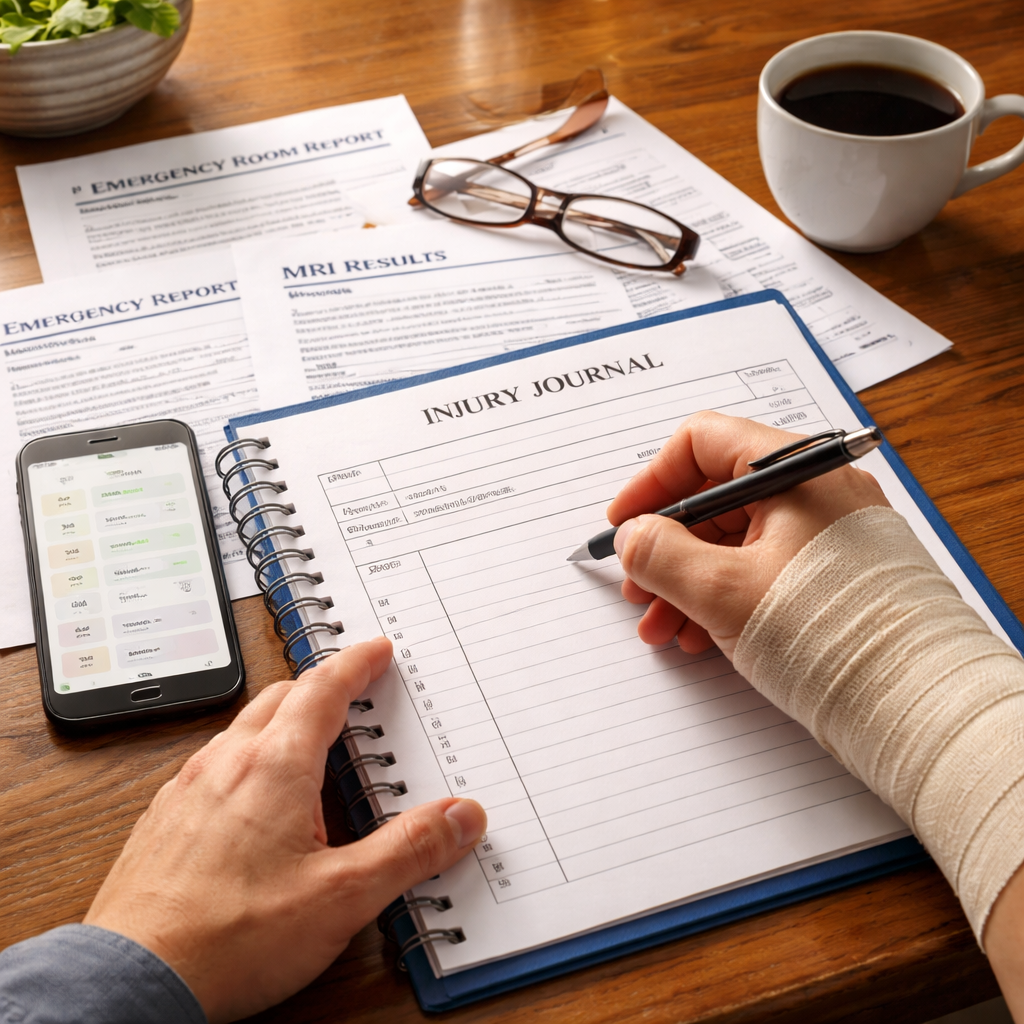
For more on why medical paperwork matters, read Dearie Law’s guide on medical documentation. The Romanow Law Group also shares a practical checklist on documenting injuries after a crash.
Step 3: File the Claim with Insurance and Understand the Process
Now that you have proof and medical records, it’s time to file the claim.
Contact the at‑fault driver’s insurer as soon as you can. Give them the basic facts – date, location, and a brief description. Do not give a recorded statement until you’ve spoken with a lawyer.
Ask the adjuster for a claim number and the name of the claims adjuster handling your file. Write it down. From here, most communication will go through that adjuster.
Fill out the claim form the insurer sends. Double‑check that every field is accurate. Typos can cause delays or even denial.
Attach the evidence you gathered: photos, police report, witness statements, and a summary of your medical care. The insurer will use this to decide if they’ll pay.
Keep a log of every call you make. Note the date, time, who you spoke with, and what was said. If something sounds off, you have a record to point to later.
Know your state’s deadline. Most states give you two years to file a lawsuit, but the insurance claim itself usually must be opened within a few weeks. Missing that window can shut the door on your personal injury claim after car accident.
Pro tip: send all documents via certified mail with a return receipt. That proves the insurer got your paperwork.
Here’s a simple flowchart you can sketch on a napkin:
- Accident → Gather Evidence
- Medical Care → Collect Docs
- Contact Insurer → Get Claim #
- Submit Forms + Evidence → Await Response
- Receive Offer → Evaluate
- Accept, Negotiate, or File Suit
Why the flow matters: each step builds on the last. If you skip the evidence folder, the insurer will ask for more, and you’ll waste time.
Imagine you’re in a suburban crash in Ohio. You call State Farm, get claim #12345, and mail a packet with photos, police report, and a copy of your ER note. Two weeks later you get a letter offering $5,000. You now have a clear base to negotiate.
Step 4: Negotiate Settlement or Prepare for Litigation
Most personal injury claim after car accident cases settle before trial. The goal is a fair payout without a courtroom.
First, your lawyer drafts a demand letter. It lists your injuries, medical costs, lost wages, and a number for pain and suffering. The letter leans on the evidence you collected.
Insurance adjusters often reply with a lowball figure. That’s a tactic. Don’t accept right away.
Review the offer. Compare it to the total of your documented damages. If it’s less than 70 % of your calculated loss, you have room to push.
Negotiation tactics:
- Reference similar cases with higher payouts.
- Show the adjuster the gap between their offer and your documented costs.
- Highlight any liability language from the police report.
- Warn that you’re ready to file a lawsuit if a fair offer isn’t reached.
Sometimes the insurer stalls. They hope you’ll grow tired and accept. If the back‑and‑forth drags beyond 90 days, your lawyer may file a lawsuit to keep the pressure on.
When you go to court, the same evidence you used in settlement becomes part of discovery. The insurer will have to answer under oath, which often leads them to increase their offer.
Pros of settling:
- Faster cash – you’re not waiting months for a trial.
- Lower legal fees – fewer billable hours.
- Less stress – no courtroom drama.
Cons of settling:
- You may leave money on the table.
- You give up the chance to set a legal precedent.
- Future medical needs might be undervalued.
Pro tip: always ask for a settlement amount that covers future medical estimates, not just what you’ve paid so far.
Here’s a quick decision tree:
- Is the offer ≥ 80 % of your total documented loss? – Yes → Accept. No → Continue negotiating.
- Has the insurer responded within 30 days? – No → File a lawsuit.
- Do you have strong liability proof (police report, witness)? – Yes → Leverage in talks.

For a deeper look at how lawyers push for higher offers, read McMahan Law’s negotiation guide. Nolo also breaks down when to file suit versus settle in its article on filing a lawsuit.
Conclusion
Walking through a personal injury claim after car accident can feel like a maze, but the steps are clear. Gather solid evidence right at the scene, get prompt medical care and keep every record, file the claim with the insurer while staying organized, and then negotiate hard or be ready to go to court. Each piece backs the next, and a tidy file makes insurers think twice before low‑balling you.
Take the time to build that evidence folder, use the medical journal, and don’t rush into a settlement that doesn’t cover your true losses. If you need a calculator to see what your claim might be worth, the internal link above can help you estimate. With the right prep, you’ll walk into negotiations with confidence, or you’ll have a strong case ready for trial.
Remember, the law is on your side when you have proof. Stay calm, stay organized, and let the process work for you.
FAQ
What should I do right after the crash to protect my personal injury claim after car accident?
First, make sure everyone is safe and call 911 if needed. Then, write down the date, time, location, weather, and road conditions. Take photos of all vehicles, the surrounding area, and any visible injuries. Exchange contact and insurance info with the other driver, and collect names and numbers of any witnesses. Finally, file a police report and keep a copy for your records. These steps create a solid evidence base that insurers can’t ignore.
How long do I have to file a personal injury claim after a car accident?
Most states give you two years from the date of the crash to file a lawsuit. However, the insurance claim itself usually must be opened within a few weeks. Missing the filing deadline can bar you from ever recovering compensation, even if you have strong proof. Check your state’s specific statute of limitations and act promptly.
Why is an injury journal important for my claim?
An injury journal tracks daily pain levels, activity limits, and emotional effects. It turns vague complaints into concrete data that doctors and judges can see. When you note the exact date you missed work or the night you couldn’t sleep, you create a record of non‑economic damages. This journal can tip the scales during settlement talks or at trial.
Can I negotiate a settlement without a lawyer?
You can, but insurers have teams of lawyers whose job is to keep payouts low. Without legal help, you may miss key evidence, miscalculate your damages, or accept a low offer too quickly. A lawyer knows how to craft a demand letter, cite case law, and use the evidence you gathered to push for a fair amount.
What if the insurance company offers less than my medical bills?
Don’t accept. Compare the offer to your itemized medical bills, lost‑wage statements, and future treatment estimates. If the offer is below your documented costs, ask for a detailed explanation. Use the gap as leverage in negotiations, and consider filing a lawsuit if the insurer won’t move.
How do I know if it’s worth going to trial?
Look at the difference between the insurer’s final offer and your calculated loss. If the offer is far below the total of your medical bills, lost wages, and pain‑and‑suffering estimate—say under 60 %—it may be worth suing. Also weigh the time, legal fees, and emotional strain of a trial against the extra money you might gain.
What role does the police report play in my claim?
The police report provides an unbiased snapshot of the crash. It often includes the officer’s view of fault, diagrams of vehicle positions, and witness quotes. This document can back up your version of events and help the adjuster see that you weren’t at fault. It’s also a key piece of evidence if you end up in court.
Should I share my recovery on social media?
No. Insurance adjusters monitor social accounts for anything that contradicts your claim. A photo of you hiking weeks after the crash could be used to argue your injuries aren’t serious. Keep your recovery updates private or share them only with close friends and family.
Think you have a case?
Our network of personal injury attorneys offers free consultations — no fees unless you win.
Get Your Free Case Review →