Every day, a construction worker gets hurt and wonders what to do next. The answer is simple: act fast, stay organized, and get help. In this guide you’ll learn how to file a personal injury claim for construction accident from the moment you’re hurt until you get compensation.
We’ll walk you through medical care, reporting, evidence collection, filing choices, and the types of money you can recover. Follow each step and you’ll protect your rights while the evidence stays fresh.
An examination of 25 essential checklist steps from three leading legal sites reveals that only 16% of the steps warn about common pitfalls, even though those few warnings cover the most frequent claim‑denial reasons.
| Step / Item | Description | Required Documents/Evidence | Typical Timeline | Best For | Source |
|---|---|---|---|---|---|
| Seek Immediate Medical Treatment | Obtain medical care right away and ensure the provider is authorized by the Workers’ Compensation Board unless it is an emergency. | medical records, receipts for travel expenses | immediately | Best for immediate health protection | d2triallaw.com |
| Notify Employer and Provide Written Notice | Inform your employer or supervisor of the injury details and give written notice no later than 30 days after the incident. | written notice (letter or form), copy for personal records | no later than 30 days after the injury | Best for timely employer notification | d2triallaw.com |
| Insurer Sends Statement of Rights (Form C-430S) | The insurer must provide a written Statement of Rights and any network requirements within fourteen days of the employer’s notice. | Form C-430S | within 14 days of receiving notice from your employer | Best for rights awareness | d2triallaw.com |
| File Employee Claim (Form C-3) with Workers’ Compensation Board | Submit Form C-3 to the Board promptly; the claim must be filed within two years of the injury. | accident reports, medical records, witness statements, expert testimonies | as soon as possible; must notify the Board within two years | Best for formal claim filing | d2triallaw.com |
| Submit Limited Release of Health Information (Form C-3.3) if Prior Injury | Provide a Limited Release of Health Information when you have previously injured the same body part or had a similar illness. | Form C-3.3 | — | Best for prior injury disclosure | d2triallaw.com |
| Gather Evidence for Third‑Party Claim | Collect accident reports, medical records, witness statements, and expert testimonies to support a negligence claim against third parties. | accident reports, medical records, witness statements, expert testimonies | — | Best for third‑party evidence gathering | d2triallaw.com |
| Lost Wage Benefits Eligibility | Workers miss more than seven days of work receive up to two‑thirds of lost wages, with eligibility beginning after fourteen days of disability. | proof of wages, medical reports confirming disability | after 14 days of disability | Best for wage recovery eligibility | d2triallaw.com |
| Collect visual evidence from accident scene | Gather photos or videos of the scene to prove negligence or unsafe conditions. | visual evidence | — | Best for visual documentation | plblaw.com |
| Maintain a daily journal | Record pain levels, treatments, and daily impact to demonstrate lasting effects. | daily journal entries | — | Best for ongoing health tracking | plblaw.com |
| Obtain written witness statements | Ask witnesses to provide written statements quickly while their memory is fresh. | written witness statements | as soon as possible | Best for witness testimony | plblaw.com |
| File workers’ compensation claim | Submit your claim after gathering documentation within the legal deadline. | all necessary documentation | within the legal deadline | Best for comprehensive documentation | plblaw.com |
| Employer Must Inform Insurer Within 10 Days | After receiving the employee’s notification, the employer must tell the insurer within ten days if treatment exceeds first aid or work is missed. | — | within 10 days of receiving your notification | Best for insurer notification compliance | d2triallaw.com |
| Insurer Starts Paying Benefits | If lost time exceeds seven days, the insurer must begin benefit payments within eighteen days of the injury or employer notice. | — | within 18 days | Best for benefit activation timing | d2triallaw.com |
| Minimum Weekly Benefit Amount | As of January 1, 2024, the minimum workers’ compensation benefit is $275 per week for qualifying injuries. | — | effective January 1, 2024 | Best for minimum benefit awareness | d2triallaw.com |
| Maximum Weekly Benefit Amount Adjusts Annually | The maximum weekly benefit changes each year based on the New York State Average Weekly Wage for the prior calendar year. | — | changes annually | Best for maximum benefit tracking | d2triallaw.com |
| Use Authorized Healthcare Provider | Receive treatment from a provider authorized by the Workers’ Compensation Board unless your employer’s PPO program applies. | — | — | Best for authorized care compliance | d2triallaw.com |
| Report injury to employer or supervisor | Report the injury promptly to your employer or supervisor to meet workers’ compensation deadlines. | — | as soon as possible | Best for prompt injury reporting | plblaw.com |
| Seek immediate medical care | Obtain medical treatment right away, even if the injury appears minor. | — | immediately | Best for rapid medical response | plblaw.com |
| Avoid Double‑Dipping (Subrogation Warning) | If you receive compensation from a third‑party claim, you must reimburse the workers’ compensation insurer for benefits already paid. | — | — | Best for subrogation risk avoidance | d2triallaw.com |
| Consult attorney to appeal denied claim | If the claim is denied, retain an attorney to help appeal the decision. | — | — | Best for appeal assistance | plblaw.com |
| Contact PLBH for free legal consultation | Call the firm to request a free consultation about your rights and compensation. | — | — | Best for free legal guidance | plblaw.com |
| Accident on company-owned sidewalk considered work‑related | The injury is work‑related because the sidewalk is part of the employer’s establishment for recordkeeping purposes. | — | — | Best for workplace location clarification | osha.gov |
| Accidents on public sidewalks are ordinarily not work‑related | OSHA states that accidents occurring on public sidewalks are generally not considered work‑related. | — | — | Best for public sidewalk distinction | osha.gov |
| Accident on construction site is work‑related | If a construction employee slips and falls on the construction site, the injury is work‑related because the site is part of the work environment. | — | — | Best for site accident classification | osha.gov |
| Definition of “work environment” under 1904.5(b)(1) | The work environment includes the establishment and other locations where employees are working or present as a condition of employment. | — | — | Best for legal definition insight | osha.gov |
Step 1: Get Immediate Medical Attention
When a crane drops a load or a scaffold gives way, your body may scream for help before you even realize the damage. The fastest move you can make is to see a doctor right away. You’ll think you’re just a little sore, but early treatment protects your health and builds a solid record for your personal injury claim for construction accident.
First, call 911 if the injury looks serious, like heavy bleeding, loss of consciousness, or broken bones. Even a minor‑looking cut can hide a fracture or internal injury. Paramedics will document what they see, and that report becomes part of your evidence.
Next, get to an authorized health provider as soon as you can. In most states, workers’ comp requires you to see a doctor that the board approves, unless it’s an emergency. This step avoids a “use unauthorized provider” mistake, one of the four big pitfalls that cause claim denials.
When you check in, tell the nurse that the injury happened on a construction site. Ask for a copy of all records, including X‑rays, test results, and the doctor’s notes. Keep the receipts for travel, medication, and any out‑of‑pocket costs. Those receipts later turn into money you can recover.
Don’t sign anything you don’t understand. If the provider asks you to waive your right to sue a third party, think twice. You can still file a third‑party claim later, but you must keep the option open.
Here’s a quick tip: set up a folder, digital or paper, and drop every medical document inside. Label each file with the date and type of record. This habit makes it easy to hand over the whole set when you file your personal injury claim for construction accident.
Why does timing matter? The research shows that 7 steps demand action within 30 days, and missing those early windows is the single most frequent mistake. The faster you get medical proof, the stronger your claim.
And remember, you can get a free, confidential case review from us. Just fill out the short form on our site, no cost, no obligation. We’ll match you with a local attorney who works on a contingency basis, meaning you pay nothing unless you win.

After you’ve been treated, the next step is to tell your boss. That’s covered in the next section.
Step 2: Report the Accident to Your Employer and OSHA
Imagine you’ve just gotten care and you’re still shaking. The next move is to let your employer know what happened. A written notice is the safest way to make sure there’s a record.
Write a short letter that includes the date, time, location, what you were doing, and a brief description of the injury. Keep the tone factual, no blame, just facts. Make a copy for your own records and give the original to your supervisor.
In many states, the employer must tell their workers’ comp insurer within 10 days if the injury needs more than first‑aid treatment. That deadline is a hard line. If your boss misses it, the insurer may argue you didn’t follow the rules, and that can cut your benefits.
Now, you also need to alert OSHA. Federal law says any fatality, loss of consciousness, or serious injury must be reported to Cal/OSHA right away. You can call the 24‑hour hotline at the number on the OSHA website. When you call, be ready to give:
- Employer name and address
- Exact location of the incident (site, floor, scaffold number)
- Names of any witnesses
- A brief description of what went wrong
If you can’t call, you may email the same details. The OSHA report becomes another piece of evidence that shows you followed the law.
Why report both? Employers and OSHA keep separate logs. The employer’s log feeds into workers’ comp, while OSHA’s log can trigger inspections that uncover safety violations. Those violations can later back up a third‑party claim.
Here’s a pro tip: ask your supervisor for the written injury report form that many large contractors use. Fill it out on the spot. If they don’t have one, use a plain sheet of paper, just make sure the date and details are clear.
Remember, the clock starts ticking the moment you get hurt. The earlier you file, the less chance of missing a deadline.
Need help with the paperwork? Our free case review service can walk you through the forms, no cost.
Once you’ve reported, you can start gathering proof. That’s the focus of the next step.
Step 3: Document Evidence and Gather Documentation
Evidence is the backbone of any personal injury claim for construction accident. Without it, insurers can say “we don’t know what happened.” Let’s break down what you need and how to get it.
First, take photos. Grab your phone and snap the exact spot where you fell, any broken tools, and the condition of the scaffolding or guardrails. Capture wide shots that show the whole area, then close‑ups of the specific hazard.
Second, collect witness statements. If a coworker saw the incident, ask them to write down what they saw right then. Include their name, job title, and contact info. A quick email works, but a typed, signed statement is stronger.
Third, request any incident reports from your employer. Most sites keep a log of accidents. Ask for the copy that lists the time, description, and any initial findings. That report often includes a “preliminary cause” that can be useful later.
Fourth, secure all medical records. This includes ER notes, doctor’s diagnosis, imaging results, and any follow‑up appointments. Ask the provider for a “complete medical record” packet. Keep it organized by date.Fifth, gather payroll records. If you miss work, you’ll need proof of lost wages. Pay stubs, time‑cards, or a letter from HR showing your salary all count.
Sixth, think about expert testimony. A safety engineer can explain why a missing guardrail was a breach of OSHA standards. A medical expert can link your injury to the accident and estimate long‑term effects.
Here’s a step‑by‑step checklist you can copy:
- Take photos/video within 24 hours.
- Ask witnesses for written statements immediately.
- Request the employer’s accident report.
- Obtain all medical records and receipts.
- Collect wage statements and tax forms.
- Identify potential experts (safety, medical, financial).
- Start a daily journal to track pain, meds, and activity limits.
Why keep a journal? Judges and insurers love to see a clear timeline that shows how the injury affects daily life. Write a few lines each night about pain level (0‑10), tasks you could or could not do, and any medication you took.
Now, you may wonder if you need a lawyer to collect all this. The answer is no, you can do it yourself, but a lawyer can help you get expert witnesses faster and keep the evidence organized. That’s why we offer a free, no‑obligation case review. If you’re ready, just fill out the short form and we’ll match you with a local attorney who works on a contingency basis.
Evidence checklist from Klie Law
Once your files are in order, you can decide how to file your claim.
Construction Accident Claims Guide
Step 4: Choose How to File Your Claim
Now you have the medical proof, the employer notice, and the evidence stack. The next decision is whether to file on your own or bring in an attorney.
Doing it yourself saves you the cost of a lawyer upfront, but the data shows that claimants with representation get settlements about 3.5 times higher. The trade‑off is time and stress. Below is a quick comparison to help you pick.
| Option | Pros | Cons |
|---|---|---|
| Self‑Representation | Lower upfront cost; full control over the case. | Harder to negotiate; risk of missing deadlines; limited access to experts. |
| Hire an Attorney (Contingency) | Experienced negotiator; no fees unless you win; access to investigators. | Attorney takes a share of any settlement; you must share case details early. |
If you choose an attorney, look for someone who works on a “no win, no fee” basis. That means you owe nothing unless the claim succeeds. The attorney will handle filing the Form C‑3, gathering expert testimony, and dealing with insurers.
If you go solo, you’ll need to fill out the workers’ comp forms yourself, mail them to the Board, and track every deadline. Use the checklist from the research table to stay on track, especially the 30‑day written notice and the 14‑day Statement of Rights.
Here’s a practical tip for self‑filers: set calendar alerts for each deadline (30 days, 14 days, 2‑year claim window). Treat each alert like a medical appointment, you can’t skip it.
On the other hand, an attorney can file the claim while you focus on recovery. They will also watch for the “subrogation” trap, if you win a third‑party settlement, you may need to reimburse the workers’ comp insurer. A lawyer will handle that paperwork so you don’t lose money.
Attorney vs. self‑representation insights
Take a moment now to decide which path feels right. If you’re unsure, a free case review can give you a quick opinion without any cost.
Compensation Types You May Be Eligible For
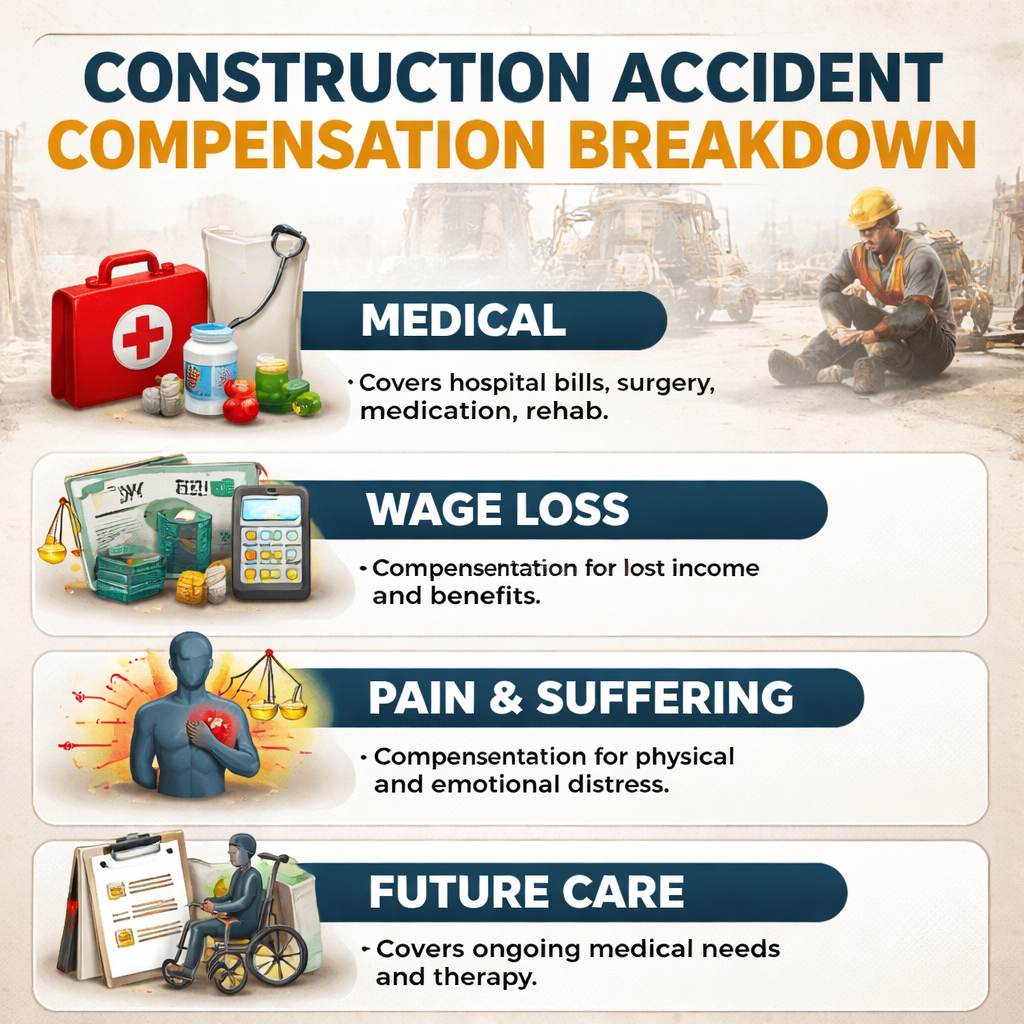
When you file a personal injury claim for construction accident, the money you can recover falls into a few buckets. Knowing each one helps you ask for the right amount.
Medical expenses cover all bills related to the injury, hospital stays, surgeries, physical therapy, medication, and even future procedures that doctors predict you’ll need.
Lost wages replace the income you missed while you were off work. Workers’ comp usually pays two‑thirds of your average weekly wage after a 14‑day waiting period. If your injury prevents you from returning to the same job, you may claim “loss of earning capacity” for the rest of your career.
Pain and suffering is non‑economic. It compensates for the physical discomfort and emotional stress you live with. Courts look at the severity of the injury, recovery time, and impact on daily life.
Loss of consortium may be claimed by a spouse or partner if the injury limits your ability to help with household tasks or intimacy.
Future medical costs are a projection of care you’ll need down the road. This can include ongoing physical therapy, joint replacements, or assistive devices.
Here’s why each matters. Imagine you broke a back while on a scaffold. Immediate surgery costs $20,000. You miss six months of work, losing $15,000 in wages. You also endure chronic pain that limits your hobbies and family time. A full settlement could look like:
- $20,000 for medical bills
- $15,000 for lost wages
- $30,000 for pain and suffering (based on injury severity)
- $10,000 for future care
- $5,000 for loss of consortium
That adds up to $80,000. Without proper evidence, you might only get the $20,000 medical portion from workers’ comp.
Remember the research finding that 44% of steps list exact documents, but only a few give mandatory forms. That means you need to be proactive in gathering every receipt, statement, and report.
One more tip: keep a spreadsheet that tracks each expense, the date, and who you paid. This makes it easy to total up the numbers when you or your lawyer prepares the demand letter.
When you’re ready, a free case review can help you see which of these compensation types apply to your situation.
Conclusion
Filing a personal injury claim for construction accident may feel overwhelming, but the steps are clear. First, get medical care right away. Then tell your employer and OSHA within the required timeframes. Next, gather solid evidence, photos, witness statements, medical records, and wage proof. Decide if you’ll go it alone or hire a lawyer who works on a contingency basis. Finally, understand the compensation you can claim and keep every receipt.
Each piece of the puzzle protects your right to recover what you deserve. The sooner you act, the stronger your claim will be. If any part of the process feels too heavy, remember our free, no‑obligation case review is here to match you with a qualified attorney at zero cost. You pay nothing unless you win.
Take the first step today. Fill out the short form on our site, get matched, and let a seasoned lawyer handle the legal maze while you focus on healing.
FAQ
What is the deadline to file a personal injury claim for construction accident?
Most states require you to file a workers’ compensation claim within two years of the injury, but you should act within 30 days to give your employer written notice. Missing the early deadlines can lead to claim denial, so start the paperwork as soon as you’re stable enough to do so.
Can I still file a claim if I was partially at fault?
Yes. Many states follow a comparative negligence rule, meaning you can recover as long as you’re not more than 50% at fault. Your award will be reduced by your percentage of responsibility, so it’s still worth pursuing.
Do I need a lawyer to claim pain and suffering?
You don’t have to, but a lawyer can help you value non‑economic losses. They’ll gather medical opinions and daily journal entries that show how the injury affects your life, which can boost the pain‑and‑suffering portion of your settlement.
What if the accident involved a subcontractor?
That opens a third‑party liability claim. You can sue the subcontractor, the equipment maker, or the property owner for negligence. Keep the “Gather Evidence for Third‑Party Claim” step in mind and collect any contracts or safety logs that name the subcontractor.
How does subrogation affect my settlement?
If you win a third‑party settlement, the workers’ comp insurer may demand repayment for benefits they already paid. This is called subrogation. An attorney can coordinate the payments so you don’t end up paying twice.
What records prove lost wages?
Pay stubs, tax returns, a letter from your employer confirming salary, and a signed statement of the days you missed work all serve as proof. Pair these with medical notes that show why you couldn’t work.
Is the free case review really no‑cost?
Yes. Our service matches you with a local attorney who works on a contingency basis. You pay nothing unless the attorney recovers money for you. The review itself is confidential and carries no obligation.
Can I file a claim if the injury happened on a public sidewalk?
Generally, injuries on public sidewalks are not considered work‑related, according to OSHA. However, if you were on a work‑related task, like carrying materials for a job, the injury may still be covered. Document the purpose of your presence and discuss it with a lawyer.
Think you have a case?
Our network of personal injury attorneys offers free consultations — no fees unless you win.
Get Your Free Case Review →