Time runs fast after an injury. If you miss the deadline, you lose the chance to get paid. In this guide we walk you through every move you need to make so you stay inside the personal injury statute of limitations.
We’ll show you how to spot the right clock, add the correct years, watch for tolling tricks, file on time, and what happens after you file. By the end you’ll know exactly what to do and why it matters.
Here’s the data that backs our steps.
| State | Limitation Period | Claim Type | Best For | Source |
|---|---|---|---|---|
| Free Case Review (Our Pick) | — | — | Best for free case intake | freecasereview.io |
| Maine | 6 years | personal injury | Best for 6‑yr limit – Maine | the702firm.com |
| North Dakota | 6 years | personal injury | Best for 6‑yr limit – North Dakota | the702firm.com |
| Alabama | 6 years | trespass to person or liberty (e.g., false imprisonment, assault and battery) | Best for 6‑yr limit – Alabama | law.cornell.edu |
| Florida | 4 years | assault, battery, false arrest, malicious prosecution, malicious interference, false imprisonment, or any other intentional tort | Best for 4‑yr limit – Florida | law.cornell.edu |
| New Mexico | 3 years | injury to the person or reputation of any person (personal injury) | Best for 3‑yr limit – New Mexico | law.cornell.edu |
| Nevada | 2 years | personal injury | Best for 2‑yr limit – Nevada | the702firm.com |
| Alaska | 2 years | libel, slander, assault, battery, seduction, false imprisonment | Best for 2‑yr limit – Alaska | law.cornell.edu |
| Colorado | 2 years | tort actions (including negligence, trespass, malicious abuse of process, malicious prosecution, outrageous conduct, interference with relationships) | Best for 2‑yr limit – Colorado | law.cornell.edu |
| Hawaii | 2 years | libel or slander | Best for 2‑yr limit – Hawaii | law.cornell.edu |
| Tennessee | 1 year | personal injury | Best for 1‑yr limit – Tennessee | the702firm.com |
| Arizona | 1 year | malicious prosecution, false imprisonment, or injuries done to character or reputation by libel or slander, seduction | Best for 1‑yr limit – Arizona | law.cornell.edu |
| Arkansas | 1 year | special actions on the case, criminal conversation, alienation of affection, assault and battery, false imprisonment, slander, libel with special damages | Best for 1‑yr limit – Arkansas | law.cornell.edu |
| California | 1 year | libel, slander, assault, battery, false imprisonment, seduction, injury, or death from wrongful act or neglect | Best for 1‑yr limit – California | law.cornell.edu |
| District of Columbia | 1 year | libel, slander, assault, battery, false imprisonment, mayhem, wounding, malicious prosecution, false arrest | Best for 1‑yr limit – District of Columbia | law.cornell.edu |
| Georgia | 1 year | injury to reputation (defamation) | Best for 1‑yr limit – Georgia | law.cornell.edu |
Step 1: Determine If Your Claim Falls Within the Limitations Period
First, ask yourself if the injury happened at all. If you were in a car crash, a slip, or a fall, you have a claim. If you can prove another party was negligent, you’re in the game.
The personal injury statute of limitations starts the day you know, or should know, about the injury. In New York, the clock starts when you suffer the injury.Read the New York rulefor a clear example.
In North Carolina, you get three years from the date of injury.See how the three‑year rule works there. If you wait too long, the court will throw out your case even if you have strong evidence.
Why does this matter? Because evidence fades. Witnesses forget details. The longer you wait, the weaker your case becomes.
Practical tip: Write down the accident date, what happened, and who was involved within 24 hours. Keep that note safe.
Another tip: Gather medical records right away. Even a simple doctor’s note can prove you were injured.
And remember, you can always get a free case review from us. We’ll check if your claim fits inside the personal injury statute of limitations at no cost.
Step 2: Identify the State‑Specific Deadline
Each state has its own rule. Some give you two years, some only one.
Look up your state’s limit. For example, Nevada gives you two years for a personal injury claim.The Martinian Law chartlists all the states side by side.
Alaska also uses a two‑year rule, but the claim types differ. In Maryland, the standard limit is three years, but there are extra rules for minors.
Why check the state table? Because a mistake can cost you your right to sue.
Practical tip: Write the deadline on a calendar. Set a reminder a month before it ends.
Another tip: If you move to another state, the original state’s deadline usually stays in force.
We also recommend checking the state’s official statutes for any recent changes.
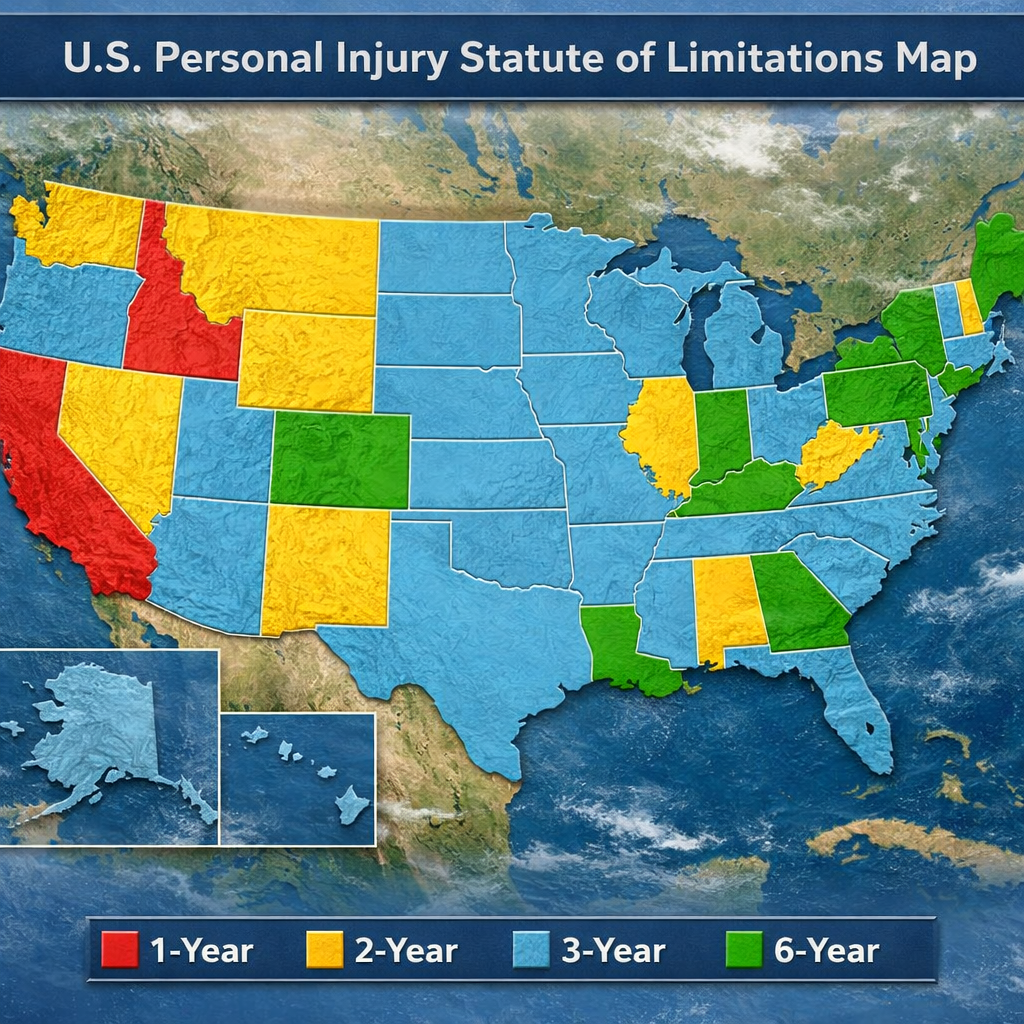
Step 3: Calculate the Start Date and Add the Limit
Take the date of the accident. That’s your start date. Then add the number of years your state allows.
Example: You were injured in Colorado on March 15, 2024. Colorado’s limit is two years. Your filing deadline is March 15, 2026.
Make a simple table to track this:
| State | Accident Date | Limit (Years) | Filing Deadline |
|---|---|---|---|
| Colorado | Mar 15 2024 | 2 | Mar 15 2026 |
| Florida | Jun 10 2024 | 4 | Jun 10 2028 |
| Tennessee | Jan 5 2024 | 1 | Jan 5 2025 |
Why use a table? It lets you see at a glance which claims are safe and which need urgent action.
Tip: Keep this table in a secure digital note you can access anywhere.
Tip: Double‑check the math with a friend or an attorney.
If you’re unsure, reach out for a free review. We’ll verify the deadline for you.
Step 4: Understand Exceptions and Tolling Provisions
Sometimes the clock stops. That’s called tolling.
In Maryland, if the injured person is a minor, the limit pauses until they turn 18, then they get three more years.Read the Maryland rulesfor details.
Another example: If the defendant hides their identity, the clock may pause until you discover them. See how tolling agreements work.
Why care about tolling? It can give you extra time when the usual deadline is too short.
Tip: Keep records of any discovery of new facts that might trigger tolling.
Tip: Ask an attorney if any of the common tolling reasons apply to your case.
Our free case review can spot tolling opportunities you might miss.
Step 5: File Your Claim Before the Deadline
Now that you know the date, it’s time to file.
The filing process usually starts with a complaint. That’s a legal paper that says who hurt you, how, and what you want.
Most states let you file online or in person at the clerk’s office. In Nevada, you can file electronically through the state court portal.
Why file early? Early filing locks in evidence while it’s fresh.
Tip: Use a checklist. Our free case review provides a step‑by‑step checklist you can download.
Tip: Keep copies of everything you send.
Tip: Send your complaint via certified mail so you have proof of delivery.
And don’t forget to attach the video below that explains the filing steps in plain language.
After you file, the court will assign a case number. Keep that number safe.
If you need help, our free case review can connect you with a local attorney who works on a contingency basis , you pay nothing unless you win.
Step 6: After Filing , What Comes Next?
Once the complaint is filed, the defendant gets a chance to respond. That’s called an answer.
The answer may admit or deny your claims. If they deny, the case moves toward discovery.
Discovery is the phase where both sides exchange evidence. It can include medical records, police reports, and witness statements.
Why is discovery important? It forces the other side to reveal what they know, which can strengthen your position.
Tip: Organize your documents by date and type. A tidy folder helps your lawyer work faster.
Tip: Respond to any requests from the other side promptly. Missing a deadline can hurt your case.
In Texas, the timeline from filing to settlement can stretch from six months to 18 months.Read the Texas timeline detailsfor a realistic view.

If the other side offers a settlement, you can negotiate. Our referral service can match you with an attorney who knows how to get the best deal.
If you reach a settlement, you’ll sign a release. That ends the case.
If no settlement, the case may go to trial. That’s why you need a good lawyer from the start.
FAQ
What is the personal injury statute of limitations?
The personal injury statute of limitations is the time limit set by each state for filing a lawsuit after you’re hurt. It usually starts on the day you know about the injury and can be as short as one year or as long as six years, depending on where you live.
How do I know which deadline applies to me?
Check your state’s specific limit. You can use the state‑specific chart from Martinian Law or ask for a free case review. Write the deadline on a calendar and set a reminder well before it ends.
Can the deadline be extended?
Yes, certain situations toll the clock. For example, if you’re a minor, the limit pauses until you turn 18, then you get a few more years. Hidden defendants or fraud can also stop the clock. Talk to a lawyer about tolling.
What happens if I miss the deadline?
If you miss the personal injury statute of limitations, the court will likely dismiss your case, even if you have a strong claim. That means no compensation for your injuries.
Do I have to pay anything to start my case?
No. Our free case review service is free, confidential, and has no obligation. You only pay if you win, because we work on a contingency fee basis.
How long does the whole process take?
From filing to settlement can take six months to 18 months, depending on the state and complexity. Some cases settle early, while others go to trial. Starting early helps keep evidence fresh.
Conclusion
Understanding the personal injury statute of limitations is the first step to protecting your right to compensation. We’ve walked you through checking if your claim fits, finding the right state deadline, doing the math, watching for tolling, filing on time, and what to expect after filing.
Remember, the clock is always ticking. Act fast, gather evidence, and use our free case review to make sure you stay inside the deadline. With the right help, you can focus on healing while we help you get the compensation you deserve.
If you’re ready to take the next step, submit your details today. Our team will match you with a qualified local attorney within 24 hours , at no cost and no obligation.
Think you have a case?
Our network of personal injury attorneys offers free consultations — no fees unless you win.
Get Your Free Case Review →